
Bisabolol is widely known as a soothing cosmetic active, but the real formulation question is more specific: which bisabolol form are you buying, and how much active (-)-alpha-bisabolol does it actually contain?
Key Takeaways
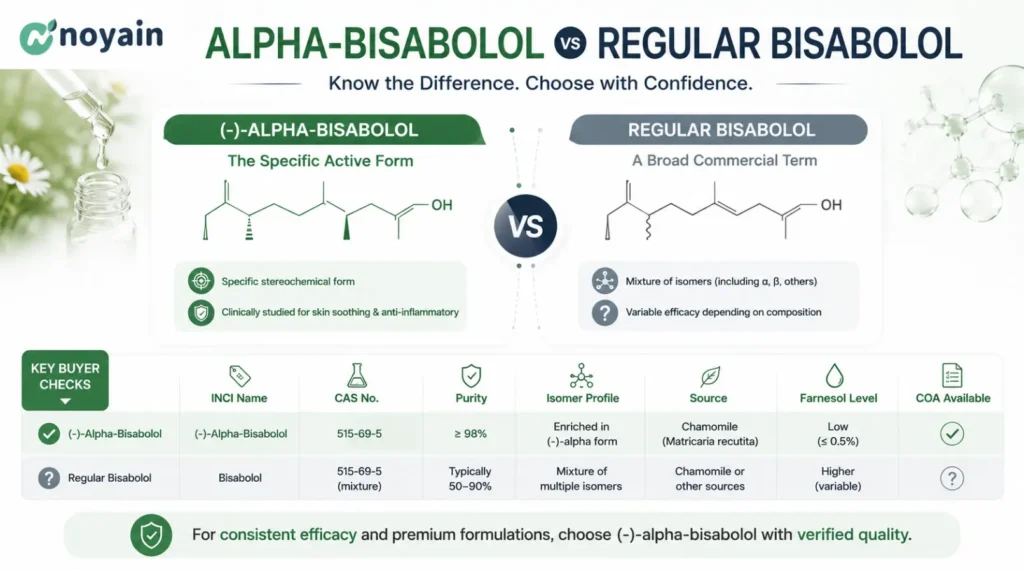
- Bisabolol is often used as a broad commercial name, while (-)-alpha-bisabolol is the specific stereochemical form most relevant to high-performance soothing skincare.
- The difference matters because bisabolol can exist as multiple isomers, and different production routes can affect active-form profile, purity, farnesol level, and supply stability.
- For cosmetic buyers, “bisabolol” on a label is not enough. You should check INCI, CAS, purity, active isomer profile, farnesol level, source, and documentation.
- For formulators, (-)-alpha-bisabolol is oil-soluble, usually used at low levels, and fits sensitive-skin, redness-care, after-sun, post-procedure, and retinol-support formulas.
- NOYAIN Bisabolol is designed around a single (-)-alpha structure, >98% purity, 98% bio-based carbon content, and farnesol <0.5% for sensitive-skin positioning.
Quick Answer: Are Alpha-Bisabolol and Bisabolol the Same?
Not exactly. In everyday cosmetic language, people often use “bisabolol” and “alpha-bisabolol” interchangeably. But from a sourcing and formulation perspective, they are not always the same.
Bisabolol can refer to a broader family or commercial material. Alpha-bisabolol refers to the alpha structural form. (-)-alpha-bisabolol, also known as levomenol, is the levorotatory alpha form commonly associated with chamomile-derived soothing activity.
This is why the purchasing question should not be “Do you supply bisabolol?” A better question is: what is the active form, and how pure is it?
For brands developing sensitive-skin or redness-care products, this distinction can affect claims support, documentation quality, batch consistency, and how confidently your team can position the ingredient. If you need a product source, our NOYAIN Bisabolol is specified as (-)-alpha-bisabolol with a single levorotatory structure.
Why This Matters for Cosmetic Buyers
If you are sourcing bisabolol for a cosmetic formulation, the difference is not just terminology. It is a quality-control and procurement issue.
Different bisabolol grades can vary significantly in:
- Active isomer content
- Purity and assay
- Farnesol specification
- Regulatory documentation
- Odor and color consistency
- Supply stability and scale-up reliability
These factors directly affect formulation consistency, sensitive-skin positioning, and long-term procurement risk. A low-cost bisabolol grade may look attractive during sample screening, but if the isomer profile, allergen trace level, or documentation package is unclear, the real cost may appear later during claim review, stability testing, or supplier qualification.
That is why this article focuses on alpha-bisabolol vs bisabolol as a buying and formulation decision, not just a naming question.
Why the “Alpha” Form Matters
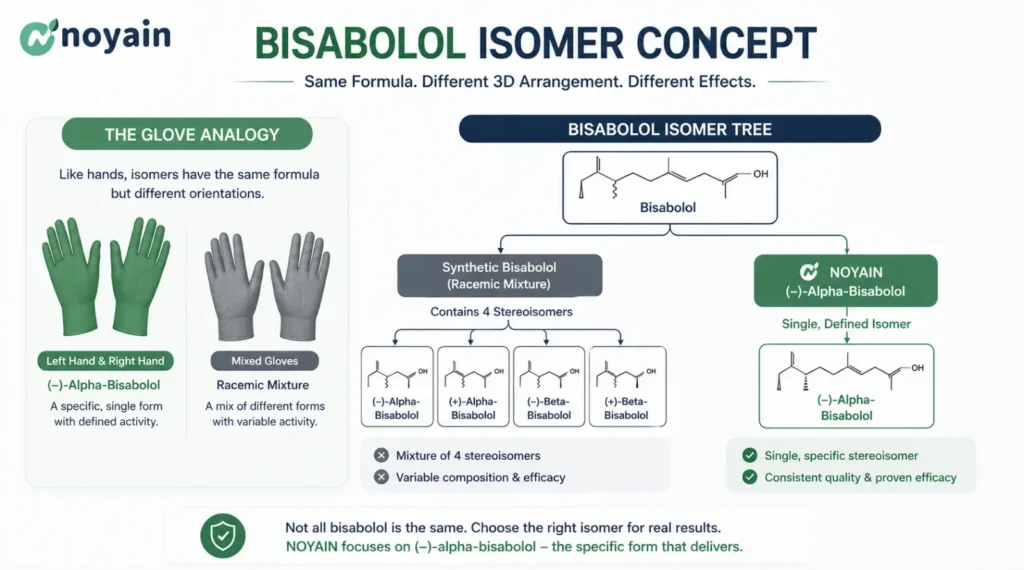
Bisabolol is a sesquiterpene alcohol. That sounds simple until you look at its stereochemistry. The molecule can exist in different spatial arrangements, and those arrangements can influence how the material behaves in biological and cosmetic systems.
A useful analogy is a pair of gloves. A left-hand glove and a right-hand glove may be made from the same material and look similar on a table, but only one fits the intended hand perfectly. Stereoisomers work in a similar way: the atoms may be the same, but the 3D arrangement is different. In a formula, that difference can influence activity, odor profile, consistency, and how confidently you can link the raw material to published alpha-bisabolol data.
For bisabolol buyers, the issue is not academic. A product described only as “bisabolol” may come from plant extraction, chemical synthesis, or biotechnology. Depending on the route, the material may differ in:
- Active isomer profile
- Purity
- Odor and color
- Trace allergen profile
- Batch-to-batch consistency
- Sustainability and supply stability
That is why we recommend asking for a COA that clearly supports the product identity, not just a marketing sheet that says “bisabolol.”
Regular Bisabolol, Alpha-Bisabolol, and (-)-Alpha-Bisabolol
Here is the practical way to think about the names.
| Name Used in Market | What It Usually Means | What Buyers Should Check |
|---|---|---|
| Bisabolol | Broad commercial name; may not specify isomer profile | INCI, CAS, assay, active form, COA details |
| Alpha-Bisabolol | Alpha structural form; often used for skincare soothing actives | Whether it is (-)-alpha, (+)-alpha, or a mixture |
| (-)-Alpha-Bisabolol | Levorotatory alpha form, often associated with chamomile-type activity | Purity, source route, farnesol level, batch consistency |
| Synthetic Bisabolol | May be a mixed-isomer or racemic product depending on process | Isomer distribution, impurities, odor, allergen trace profile |
| Biosynthetic Bisabolol | Produced by biotechnology or fermentation route | Bio-based carbon, active form, purity, scale-up reliability |
The INCI name often appears as Bisabolol, but procurement should go deeper than INCI alone. For B2B cosmetic raw materials, INCI tells you how the ingredient appears on the product label; it does not always tell you the full quality profile of the raw material.
That is where technical documents matter. A strong supplier should be able to provide a COA, TDS, MSDS/SDS, specification sheet, and clear information on source route and active form.
How Different Production Routes Affect Bisabolol Quality
Production route is one of the most useful ways to understand why two bisabolol samples can look similar on a quotation sheet but behave differently in procurement and formulation review.
| Source | Typical Characteristics | Buyer Watch Points |
|---|---|---|
| Chamomile or Candeia Extraction | Natural origin story, familiar botanical association, often linked to traditional soothing claims | Variable supply, lower yield, crop or forestry dependence, possible price fluctuation |
| Chemical Synthesis | Cost-effective and scalable, useful for commodity supply | Possible mixed isomers, higher need to verify active-form profile, impurity and allergen trace control |
| Biosynthetic Production | High purity, scalable production, stable quality, naturally identical positioning | Verify bio-based carbon, fermentation route documentation, COA consistency, allergen specifications |
This is where natural bisabolol, synthetic bisabolol, and biosynthetic bisabolol become more than SEO keywords. They describe different sourcing realities.
For example, chamomile extraction may support a botanical story, but natural sourcing can be limited by yield and agricultural variability. Chemical synthesis can support scale and price competitiveness, but buyers should confirm whether the material is a mixed-isomer grade. Biosynthetic production can offer a stronger balance for cosmetic brands: controlled quality, high purity, scalable supply, and a sustainability story that is easier to document.
NOYAIN Bisabolol uses biosynthesis and enzymatic catalysis to target a high-purity, single (-)-alpha structure with 98% bio-based carbon content. For procurement teams, this means the production route supports not only marketing positioning, but also batch consistency and long-term supply planning.
What Makes NOYAIN Bisabolol Different?
NOYAIN Bisabolol is not positioned as a generic soothing oil. It is designed as a high-purity cosmetic active for formulators who need a more controlled raw material.
Core specification profile:
| Parameter | NOYAIN Bisabolol |
|---|---|
| INCI Name | (-)-alpha-Bisabolol |
| CAS No. | 23089-26-1 |
| Molecular Formula | C15H26O |
| Molecular Weight | 222.4 |
| Active Form | Single (-)-alpha levorotatory structure |
| Purity | >98% |
| Bio-based Carbon Content | 98% |
| Farnesol | <0.5% |
| Appearance | Transparent, colorless to light yellow liquid |
| Odor | Light floral scent |
| Solubility | Oil-soluble |
| Recommended Use Level | 0.01%-1.0% |
The main difference is the combination of single active form + high purity + biosynthetic production.
Traditional plant extraction can be limited by raw material availability and long growth cycles. Chemical synthesis can be scalable, but buyers need to watch for mixed-isomer profiles and trace by-products. NOYAIN uses biosynthesis and enzymatic catalysis to produce a high-purity, naturally identical material with a more controlled active-form profile.
For sensitive-skin brands, the farnesol point is also important. Farnesol is a fragrance allergen that can be relevant when brands are building low-allergen or sensitive-skin positioning. NOYAIN Bisabolol controls farnesol at <0.5%, giving procurement and R&D teams a clearer quality story to evaluate.
Why Formulators Care About the Active Form
In a formula, bisabolol is usually chosen for a specific job: calming visible redness, improving comfort, supporting skin repair positioning, or making a stronger irritation-control story around actives such as retinol or brightening ingredients.
If the raw material is poorly defined, the formulator has less confidence in the link between the ingredient, the supporting data, and the final product claim strategy.
From our technical data, NOYAIN Bisabolol supports several formulation directions:
- Anti-inflammatory and soothing positioning: in vitro data showed TNF-alpha inhibition of 32.2% and IL-6 inhibition of 10.5% in a macrophage inflammation model.
- Anti-itch and calming positioning: mast cell degranulation inhibition reached 27.30% in the internal test model.
- Redness-care positioning: human soothing tests showed strong redness-reducing performance at 0.1% use level.
- Skin repair positioning: a keratinocyte scratch assay showed a 17% improvement in wound-closure area at 0.001%.
- Microbial-balance support: internal antimicrobial testing showed inhibition against Staphylococcus aureus, Propionibacterium acnes, and Malassezia furfur under specific test conditions.
These data points should be used carefully. They support cosmetic formulation positioning; they are not medical treatment claims. In customer-facing skincare language, we recommend wording such as “helps soothe,” “supports comfort,” “helps reduce visible redness,” or “supports barrier-repair formulas.”
Practical Formulator Notes
When I look at bisabolol for a sensitive-skin formula, I do not start with the marketing phrase “soothing active.” I start with three practical questions:
- Can I dissolve it cleanly in my system?
- Does the supplier give me enough documentation to defend the claim?
- Is the quality profile consistent enough for scale-up?
When incorporating (-)-alpha-bisabolol into a sensitive-skin formula, the evaluation should rely on technical parameters rather than marketing concepts. Key variables include solubility, process temperature, pH compatibility, and documentation validity.
Process temperature: while (-)-alpha-bisabolol is chemically stable under standard cosmetic processing conditions, we recommend adding it during the cool-down phase, ideally below 45°C, when the formula allows. This helps preserve its delicate organoleptic profile and reduces unnecessary exposure to heat.
pH versatility: supplier data and practical formulation experience support broad compatibility across common cosmetic pH ranges. For screening, we usually treat pH 3.0-11.0 as a practical evaluation window, then confirm stability in the final formula. This makes bisabolol useful not only in pH 5-6 sensitive-skin emulsions, but also in low-pH exfoliating systems and higher-pH rinse-off or surfactant systems.
Solubilization: bisabolol is oil-soluble and miscible with many cosmetic oils, esters, and non-polar solvents. In emulsions, it usually belongs in the oil phase or cool-down phase depending on the system. For crystal-clear aqueous serums, essences, or toners, a hydrotroping agent or non-ionic solubilizer, such as a suitable polyglyceryl ester system, may be required.
For a first bench trial, I would usually test several levels rather than jump directly to the top of the range. A common screening approach is:
Example Screening Range
0.05% Bisabolol ..... light soothing support
0.10% Bisabolol ..... redness-care and comfort positioning
0.20% Bisabolol ..... stronger anti-itch / calming concept testing
0.50%-1.00% ......... specialty systems, subject to sensory and stability checks
Before scale-up, validate clarity, odor impact, emulsion stability, preservative compatibility, packaging compatibility, and final product irritation profile. Bisabolol is often gentle, but the finished formula still needs its own safety and stability evaluation.
Compatibility Snapshot
This table is a practical starting point for R&D screening. It does not replace final stability testing, but it helps formulators decide whether bisabolol belongs in the first prototype.
| Parameter | Compatibility | Formulation Note |
|---|---|---|
| pH 3.0-11.0 | Excellent screening compatibility | Confirm in final system, especially with acids or alkaline surfactants |
| Electrolytes | Compatible | No major ionic conflict expected; validate texture and viscosity |
| Niacinamide | Compatible | Useful for barrier-support and redness-care formulas |
| Retinol | Recommended | Supports comfort positioning; NOYAIN internal data showed reduced irritation in a retinol compound test |
| Ceramides | Recommended | Good fit for barrier-repair and sensitive-skin emulsions |
| Vitamin C (LAA) | Compatible with testing | Bisabolol may support comfort; confirm low-pH stability and solubilization |
| VC-IP | Recommended | Internal data supports brightening synergy with VC-IP |
| Surfactant Systems | Compatible | Useful for scalp and rinse-off comfort concepts; confirm clarity and foam impact |
Best Use Cases for (-)-Alpha-Bisabolol
(-)-Alpha-bisabolol is most valuable when your formula brief requires both a technical calming story and a clean, elegant ingredient deck.
Best-fit applications include:
- Sensitive-skin serums and creams
- Redness-care moisturizers
- Barrier-repair creams and lotions
- After-sun and post-procedure skincare
- Retinol-support formulas designed to reduce discomfort
- Acne-prone skin formulas that need anti-redness support
- Scalp serums or shampoos focused on comfort and itch reduction
- Baby-care or family-care products where low-allergen positioning matters
For a broader ingredient category structure, bisabolol belongs naturally in soothing and repair ingredients, alongside actives such as panthenol, allantoin, ceramides, and centella-derived materials.
When Not to Rely on Bisabolol Alone
Bisabolol is useful, but it should not carry the whole formula story by itself.
If the product brief is deep barrier repair, pair it with ceramides, cholesterol, fatty acids, panthenol, or niacinamide. If the brief is brightening, bisabolol can support comfort, but it should be paired with a real brightening active such as VC-IP, niacinamide, tranexamic acid, or alpha-arbutin depending on the formula strategy. If the brief is acne-prone skin, do not frame bisabolol as an acne treatment; position it as anti-redness and comfort support within a broader system.
The best use of bisabolol is often strategic: it makes stronger actives easier to tolerate and makes sensitive-skin claims more credible.
For example, NOYAIN internal testing found that a 1:1 compound with retinol reduced irritation by 32%. That does not mean bisabolol “neutralizes” retinol irritation in every formula. It means formulators have a strong reason to test bisabolol in retinoid systems where comfort, redness, and user compliance matter.
Example Formula Direction
Below is not a finished commercial formula. It is a starting framework for bench testing.
Sensitive-Skin Redness-Care Emulsion Concept

Water phase ................................ q.s. to 100%
Glycerin ................................... 3.00%
Panthenol .................................. 1.00%
Niacinamide ................................ 2.00%
Light emollient blend ...................... 8.00%-12.00%
Emulsifier system .......................... supplier recommended level
NOYAIN Bisabolol ........................... 0.10%-0.20%
Preservative system ........................ q.s.
pH adjuster ................................ target pH 5.2-6.2
Formula goal: a lightweight soothing emulsion for redness-prone or easily irritated skin.
Why bisabolol fits: it supports calming, visible-redness care, and comfort positioning while staying compatible with a soft sensitive-skin claim platform.
What to verify: emulsion stability, odor impact, color stability, preservative challenge test, freeze-thaw stability, centrifuge stability, packaging compatibility, and a finished-formula irritation assessment.
Buyer Notes: What to Check Before Buying Bisabolol
If you are sourcing bisabolol for a cosmetic brand, do not evaluate suppliers only by price per kilogram. For this ingredient, quality and documentation can change the real value of the material.
Ask for:
- INCI name and CAS number
- Purity or assay result
- Active isomer profile, especially whether the material is
(-)-alpha-bisabolol - Production route: plant extraction, chemical synthesis, or biosynthesis
- Farnesol or fragrance allergen information
- COA, TDS, MSDS/SDS, and specification sheet
- Odor, color, and appearance limits
- Recommended use level and formulation guidance
- Regulatory and safety documents for your target markets
- Batch-to-batch consistency data if available
For brand teams, the supplier conversation should also include positioning. If your product line is built around sensitive skin, clean beauty, biotechnology, sustainability, or high-purity actives, a biosynthetic >98% (-)-alpha-bisabolol grade may give you a stronger story than a generic bisabolol grade.
Questions to Ask Your Bisabolol Supplier
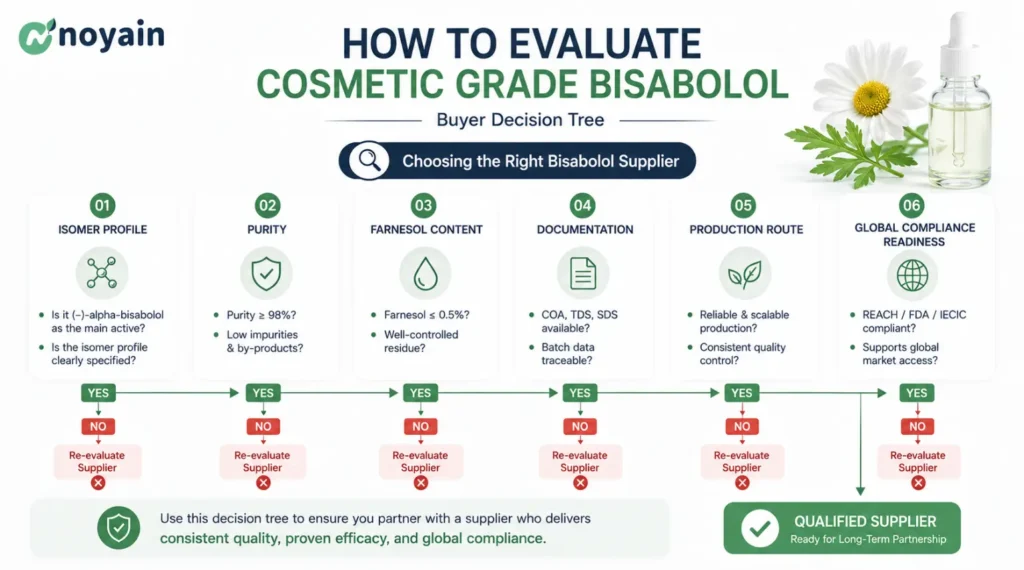
A good bisabolol article should not only educate readers; it should also help them evaluate suppliers. These questions are useful in RFQ, sample evaluation, and supplier qualification.
- Can you verify the active isomer profile?
- Is the material specified as
(-)-alpha-bisabolol, or is it a mixed-isomer grade? - What is the farnesol specification?
- How is the material produced: plant extraction, chemical synthesis, or biosynthesis?
- Can you provide batch-to-batch consistency data?
- Can you provide COA, TDS, MSDS/SDS, allergen information, and specification sheet?
- Is the material suitable for sensitive-skin positioning?
- What global-market documentation is available, such as China CSAR support, EU REACH-related documentation, Vegan, Halal, ISO, or GMP-related supplier documents?
- What are the standard lead time, MOQ, sample policy, and export document options?
This kind of checklist shifts the conversation away from “who is cheapest?” and toward “who can support a stable, defensible cosmetic product?”
FAQ
Is alpha-bisabolol the same as bisabolol?
In casual cosmetic language, the terms are often used interchangeably. Technically, bisabolol is a broader term, while alpha-bisabolol identifies a specific structural form. For purchasing, ask whether the product is (-)-alpha-bisabolol, what the purity is, and whether the supplier can document the active-form profile.
What is the CAS number of (-)-alpha-bisabolol?
NOYAIN Bisabolol is specified with CAS No. 23089-26-1. Buyers should always confirm CAS, INCI, and assay information on the COA and specification sheet.
Is bisabolol water-soluble or oil-soluble?
Bisabolol is oil-soluble. In emulsions, it is typically incorporated through the oil phase or an appropriate cool-down process. In water-based systems, formulators may need a solubilizer or premix strategy.
What percentage of bisabolol should be used in skincare?
NOYAIN recommends 0.01%-1.0% depending on the product type and claim direction. For redness-care or sensitive-skin testing, many formulators begin around 0.05%-0.20% and adjust after stability, sensory, and irritation evaluation.
Is bisabolol suitable for sensitive-skin formulas?
Bisabolol is commonly used in sensitive-skin and soothing formulas. NOYAIN Bisabolol is designed with farnesol <0.5%, high purity, and a single (-)-alpha structure. However, every finished formula still needs its own safety, stability, and compatibility testing.
What documents should buyers request?
At minimum, request a COA, TDS, MSDS/SDS, specification sheet, safety assessment support, allergen information, and any region-specific compliance documents required by your target market.
Is biosynthetic bisabolol natural?
Biosynthetic bisabolol is better described as naturally identical or bio-based, not simply plant-extracted. It is produced through biotechnology or fermentation-related processes, but the target molecule can be chemically identical to naturally occurring (-)-alpha-bisabolol. For clean beauty positioning, buyers should ask for bio-based carbon data, production route documentation, and any relevant certification support rather than relying on the word “natural” alone.
What is the difference between bisabolol and chamomile extract?
Chamomile extract is a botanical extract that may contain many compounds, while bisabolol is a specific active molecule associated with chamomile’s soothing profile. If you need a botanical story, chamomile extract may be useful. If you need controlled purity, defined use level, lower color/odor variability, and clearer documentation, cosmetic-grade bisabolol is usually easier to formulate and qualify. This will be a strong future comparison topic: Bisabolol vs Chamomile Extract.
Explore NOYAIN Bisabolol
NOYAIN Bisabolol is a biosynthetic, high-purity (-)-alpha-bisabolol designed for sensitive-skin, redness-care, repair, after-sun, scalp-care, and retinol-support formulations.
Available technical support includes:
- COA, TDS, MSDS/SDS, and specification support
- Sample request and formulation discussion
- Application guidance for emulsions, creams, serums, masks, and scalp-care products
- Support for sensitive-skin, post-procedure, after-sun, and retinol-comfort concepts
To request a sample, download documentation, or discuss your formulation needs, please contact us through our inquiry form:
→ Contact Us
Or reach us directly at [email protected]
Noyain Biochemicals
Room 3a05, 4th Floor, No. 6, Ketai Second Road, Baiyun District, Guangzhou City, China
References
- PubChem. Levomenol compound record, CID 442343.
- Cosmetic Ingredient Review. Safety assessment resources for bisabolol and related cosmetic use.
- European Commission. CosIng cosmetic ingredient database.
- Kamatou, G. P. P., & Viljoen, A. M. (2010). A Review of the Application and Pharmacological Properties of alpha-Bisabolol and alpha-Bisabolol-Rich Oils. Journal of the American Oil Chemists’ Society.
- Rocha, N. F. M., et al. (2011). Anti-nociceptive and anti-inflammatory activities of (-)-alpha-bisabolol in rodents. Naunyn-Schmiedeberg’s Archives of Pharmacology.
- Rodrigues, F. F. G., et al. (2018). In vitro antimicrobial activity of alpha-bisabolol-rich essential oil and its major constituent. Microbial Pathogenesis.
